Posted in Minoli
14th January 2026
In this third article in our Design Trends 2026 series, we’re exploring the latest directions in designing living areas and how porcelain tiles can help create flexible spaces with flow and format.
The way we use our homes has changed, with a resultant shift towards incorporating more sociable, multi-purpose living areas. This is in part the effect of less formal attitudes to cooking, entertaining and family life, and more recently a need for flexible but joined-up spaces from time spent at home during the pandemic.
While the transition to open plan living has been ongoing for decades, making homes feel more spacious, connected and contemporary, it’s widely recognised that there are pros and cons to the totality of this format.
One of the main benefits of an open-plan layout is that kitchens, dining areas, living rooms, and often entrance hallways, all flow into one. However, merging almost the entire downstairs of a property into a one undivided space, removes the potential for private, quiet retreats for simply relaxing or to accommodate today’s hybrid work style.
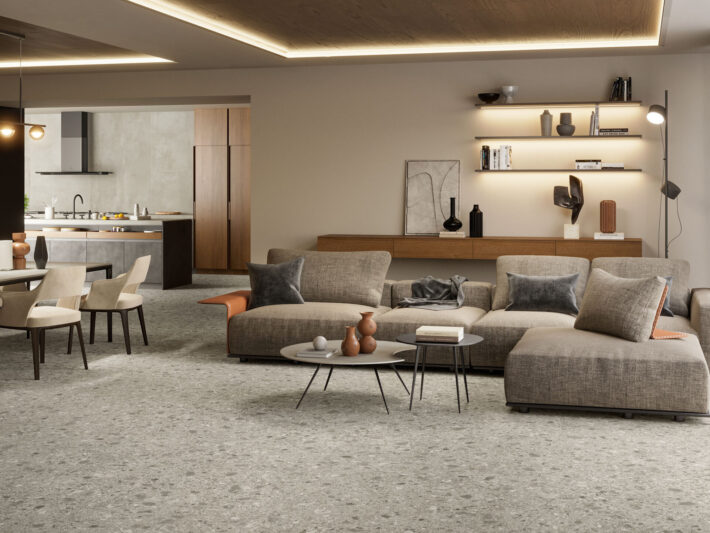
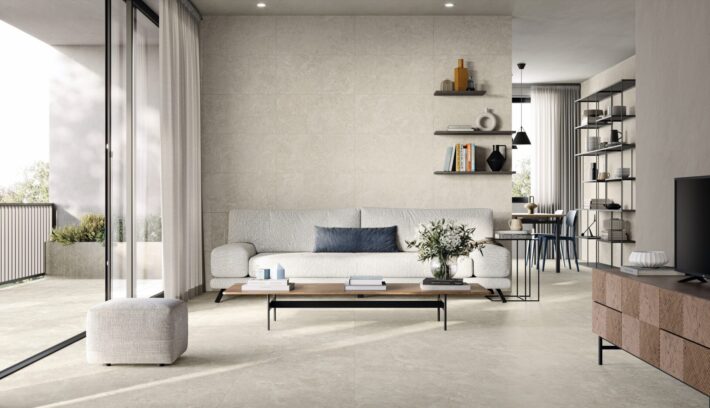
Whether a fully open plan design or a more considered approach to zoning is preferred, porcelain tiles can be used in various ways to achieve either goal.
When looking to create a singular space, the latest large format floor tiles can help create seemingly seamless surfaces through expansive areas. In 120/120, 90/90, 80/80 and 60/60 dimensions, or in coordinating rectangular shapes, these substantial sizes reduce the number of grout lines, which can also be colour matched to further reduce their visibility.
With precisely calibrated sizes within batches and exacting rectified edges, remarkable uniformity can be achieved when using a concrete, stone, travertine, marble or wood-effect design, for instance. Where the substrate is suitable and stable, extra-large slabs are also being used at 120/240 or 120/278 scale, delivering unmatched continuity.
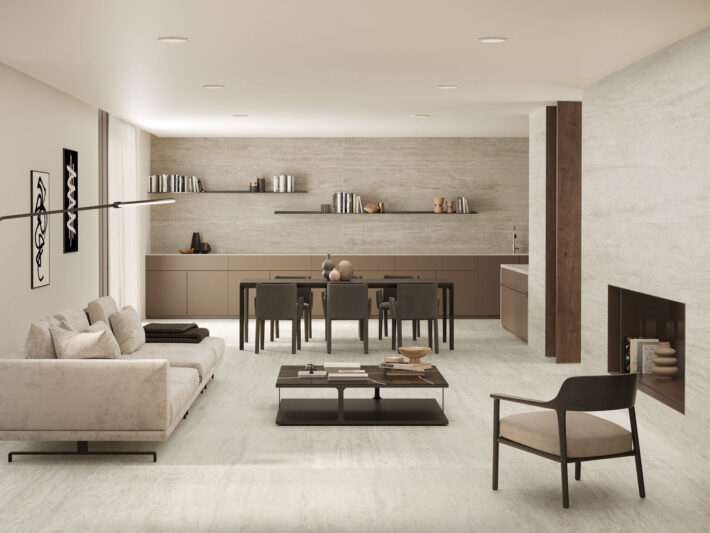
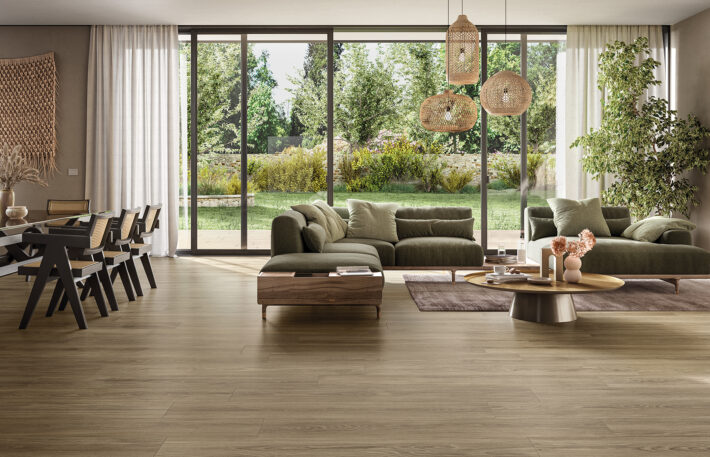
Even when individual rooms remain a requirement, in the case of WCs or utility and boot rooms, or when shutting doors to a hallway for cosiness, using a matching tile design can still deliver a flawless sense of flow between, whether closed off or not.
Thereafter, when zoning or partitioning are desired to make sense of larger rooms, to differentiate between areas or to retain partial separation, specific surface treatments also play an important role. Using different floor and wall tiles to break up but still coordinate a setting is a clever way of demarcating lounge areas from more functional food preparation stations, for example.
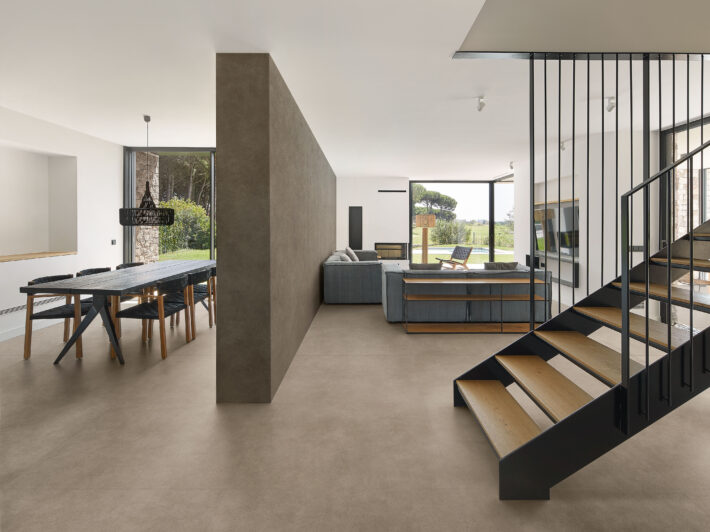
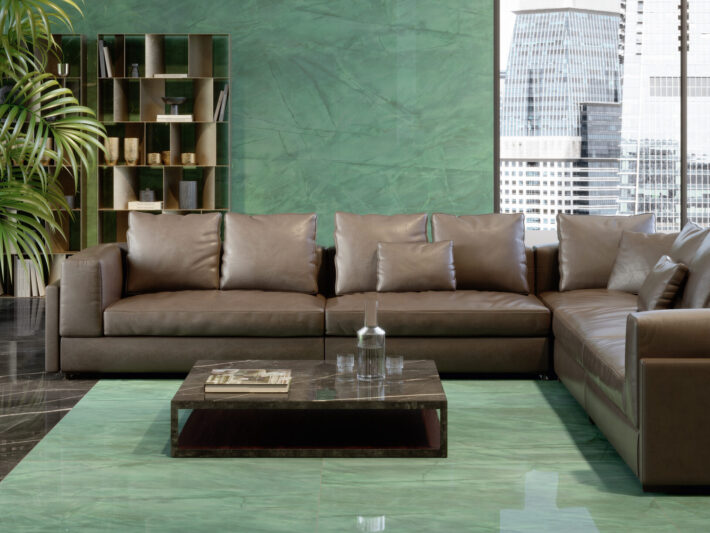
Many series in the Minoli collections have broad colour palettes, allowing different shades of the same design, in matching sizes and finishes, to be combined within rooms. Completely different designs can also be inset in panels on floors to create carpet-like anchors for dining and seating furniture, whilst keeping entirely even levels throughout the environment.
Within open-plan areas or separate living rooms, porcelain and ceramic tiles are also being used creatively to fashion features on walls or to clad individual elements such as fireplace surrounds, media walls or more structural inclusions, such as pillars and partitions. As porcelain and ceramic tiles are resilient to heat and can be cut, shaped and drilled as required, electrical wiring, switchgear and ventilation grids can all be accommodated into interior design specifications.
Either contrasting or coordinating in style, the trend for using tiles in more imaginative and inventive ways, to cover artefacts or create artwork-like installations is becoming more prevalent. Intricate décor pieces, with textured surfaces and metallic or coloured inlays, and new three-dimensional cubes in ceramic, lend themselves to being framed or stacked to create imaginative takes on room dividers, screens and decorative panels, that marry with the overall design direction of the living space.
If you’d like to talk to our team about these on trend tile designs, please do get in touch. We’d gladly discuss your needs on the phone, arrange a time for a design consultation at one of our showrooms or, for our corporate clients, arrange a meeting with your account manager.
Minoli Oxford – 01865 778225 / showroom@minoli.co.uk
Minoli London – 020 7474 2934 / thesurfacewithin@minoli.co.uk
Existing Corporate Clients – Please contact your account manager / developers@minoli.co.uk