Posted in Minoli
19th October 2026
The latest premium porcelain, large format tiles and super-sized slabs that emulate the world-renowned travertine stoneware, offer a contemporary and textured interpretation that remains faithful to the elegance and visual impact of the natural material, but with the enduring and aesthetic qualities of a modern, man-made product.
While inspired by one of the most prestigious and iconic, traditional materials, Minoli’s travertine-effect series present architects, specifiers, interior designers, property developers and homeowners with technically advanced solutions for walls and floors, inside and outdoors.
Affording such versatility of application, the breadth and depth of sizes, finishes and thicknesses, provide a complete system of surfaces with which to fulfil the most contemporary designs.
Marvel T
The result of an in-depth research study into the features of travertine, the sublime and texturally rich designs of the new Marvel T Series are creatively composed of seven muted and mellow, natural shade combinations, all with the appearance of vein cut stone, but as if cleaved from different angles.
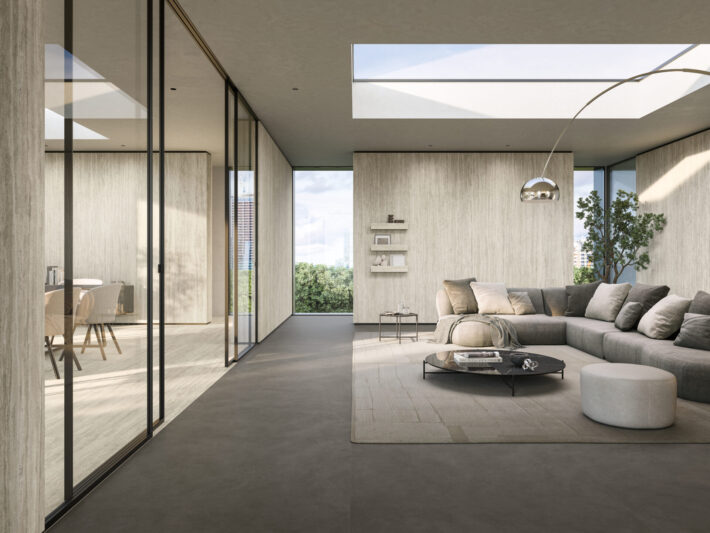
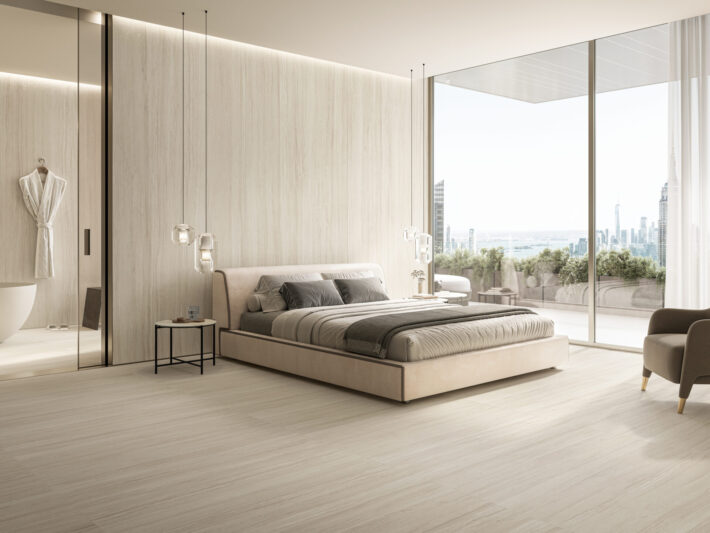
Marvel T is available in a wide variety of up to nine sizes, including large format tiles and slabs, with four different surface finishes, a choice of complementary décor designs and Outdoor specification pavers.
The principal designs in this collection, Navona and Halo with their respective White and Sand colourways, are available in the widest variety of large sizes including 80/80, 75/150, 60/120, 120/120 and 120/278 slabs, all in a Matt finish, as well as in 30/60 and 60/60 dimensions.
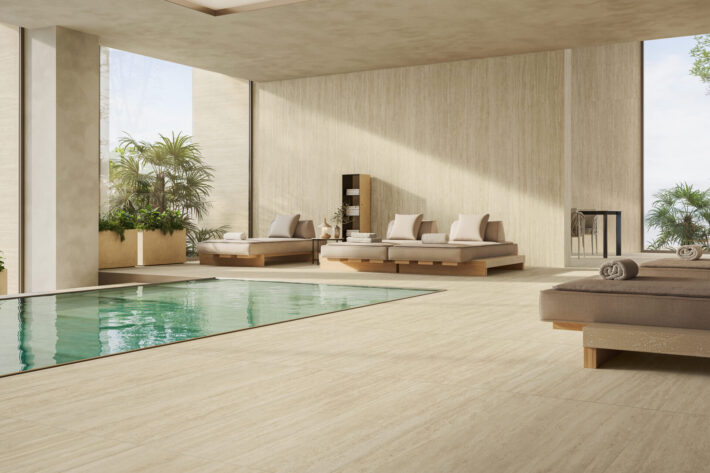
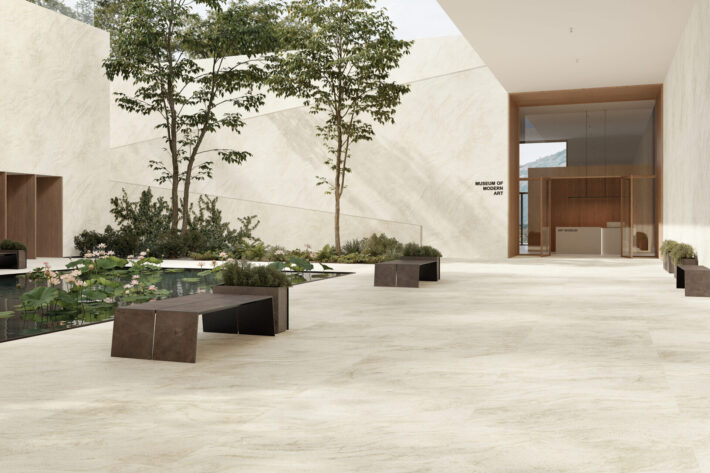
Depending on the design chosen, many of the above sizes are available in other colourways and 120/240 and 160/320 slab formats can also be ordered. The 120/278 slabs, in Halo White and Sand colourways, can be ordered in 4-piece endless kits, where the patterning can be arranged to flow across the surfaces in sequence.
Marvel Travertine
In Vein Cut and Cross Cut finishes, Marvel Travtertine has a dual identity, providing two sensuous surfaces for different design directions and a broad range of settings, including residential, commercial and hospitality.
Vein Cut, which is more akin to traditional Travertine, exposes linear streaks in the pattern, whereas Cross Cut reveals more distinct colour variation adding a greater dimension of depth to designs.
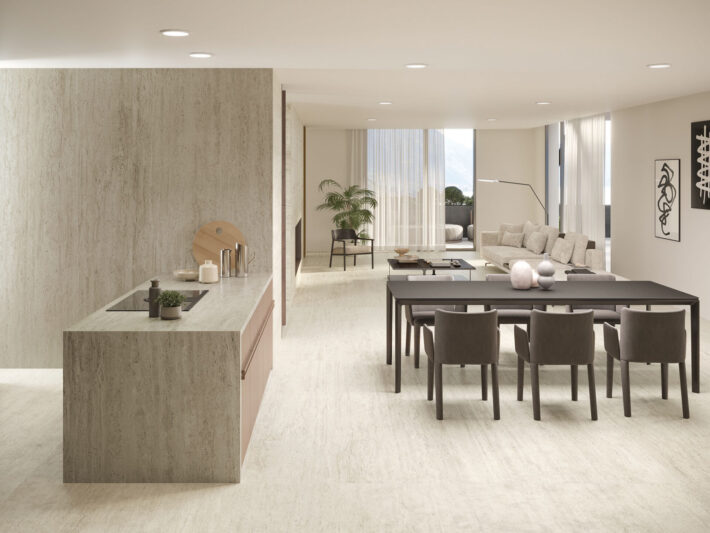
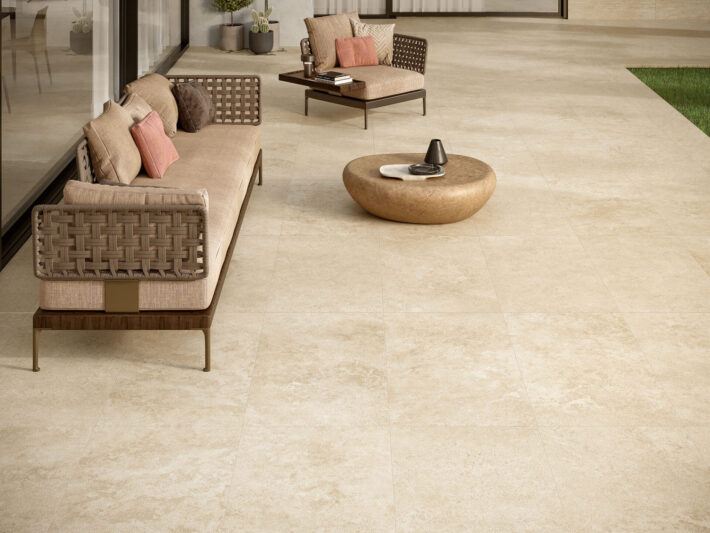
In three sublimely subtle tones, Marvel Travertine creates a calming and contemporary canvas against which to feature furniture, fixtures and fittings.
To create the architectural system of design solutions that Marvel Travertine represents, the logic behind the finishes and formats available has been carefully thought through by the leading designers in rectified porcelain production.
In a 9 mm thickness with a Matt finish the Cross Cut designs are available in 60/60, 60/120 and 120/120 formats. The Vein Cut designs are also available in the 60/120 size from UK stock, plus expansive 120/240 and 120/278 slabs, of 9 mm and 6 mm thickness respectively, offering uninterrupted, full-height wall coverage and more seamless floor surfaces.
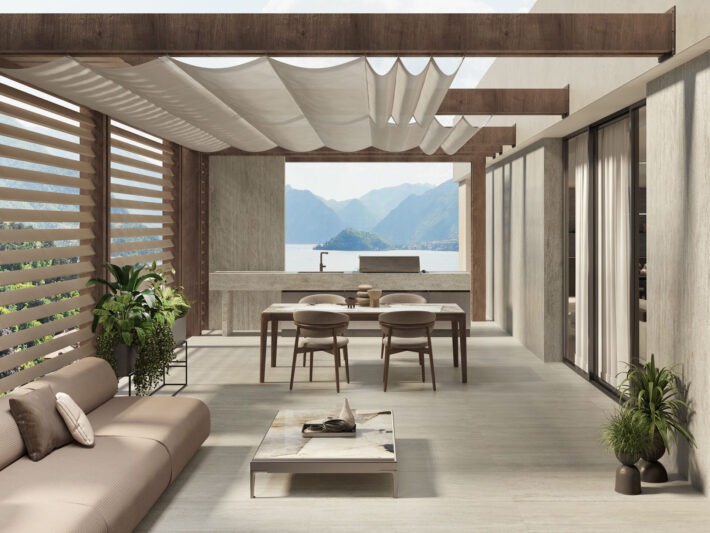
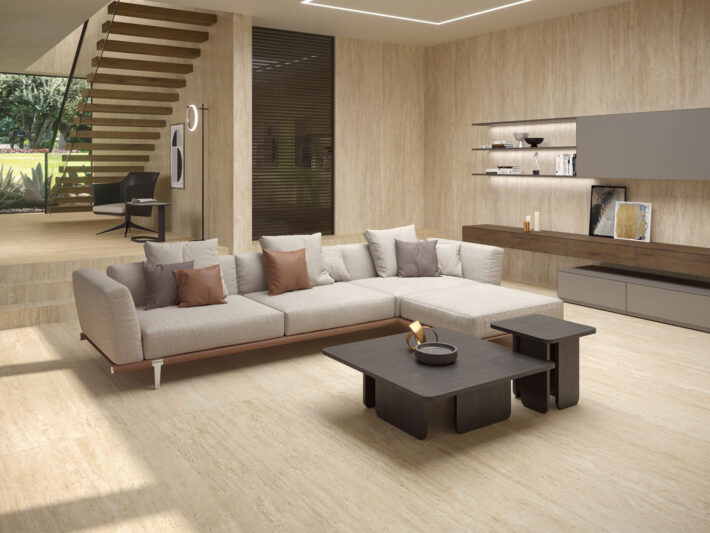
With a Textured / Grip finish, all colourways in both the Cross and Vein Cut designs are available in a 60/120 size of 9 mm thickness. All colours of the Vein Cut versions are also all available in a 60/120 size with 20 mm thickness and R11 slip-resistance rating specifically for outdoor applications.
Elysian Travertini
The Elysian Travertini Series of premium porcelain tiles and slabs is a timeless reinterpretation of Travertine stoneware.
Offering visual variety and versatility, the technically advanced textures with layered and cross-cut finishes, bring depth and movement to designs.
Emulating the linear and layered look of limestone, this highly technical take on traditional Travertine is available in three natural and nuanced shades and with two distinct patterning effects.
Enhancing the versatility and surface variety of this collection, all colours are available with Matt, Brushed or Outdoor structured finishes in an array of different dimensions from more typically sized tiles, through to large format and extra-large slabs.
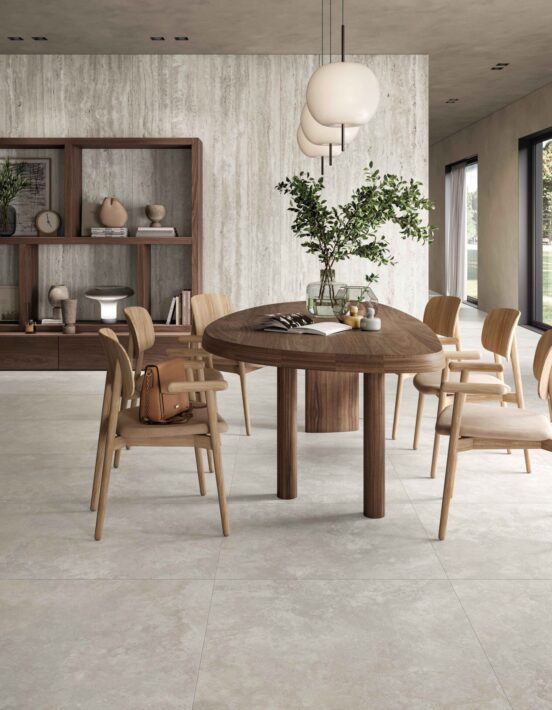
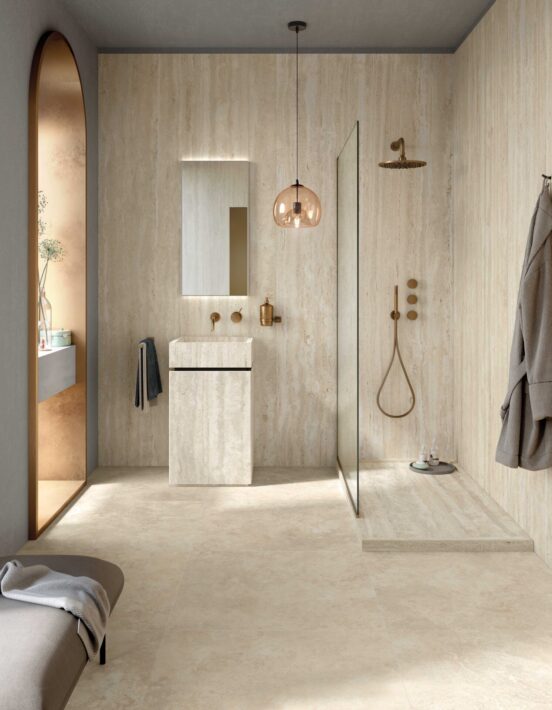
Across the range, there are no less than four Outdoor size variants in 20mm thickness depending on colour, plus coordinating sets of Mosaics and Décor pieces.
Larger format tiles include those of 60/120, 80/80 and 120/120 dimensions plus slab variants in 80/160 and 120/278 formats depending on the design chosen, as well as more standard 30/60 and 60/60 sizes.
In terms of Outdoor specification products with 20 mm thickness, Pearly Cross, Misty Cross and Light Cross are available in 60/60, 80/80 and 60/120 sizes, plus an interesting 30/120 format.
If you’d like to explore any of the Minoli Travertine-effect series with large format tiles and expansive slabs in person, or to request samples, please do get in touch.
We’d gladly discuss your needs on the phone, arrange a time for a design consultation at one of our showrooms or, for our corporate clients, arrange a meeting with your account manager.
- Minoli Oxford – 01865 778225 / showroom@minoli.co.uk
- Minoli London – 020 7474 2934 / thesurfacewithin@minoli.co.uk
- Corporate Clients – Please contact your account manager directly / developers@minoli.co.uk
- Outdoor Product Enquiries – 01865 778225 / outdoor@Minoli.co.uk